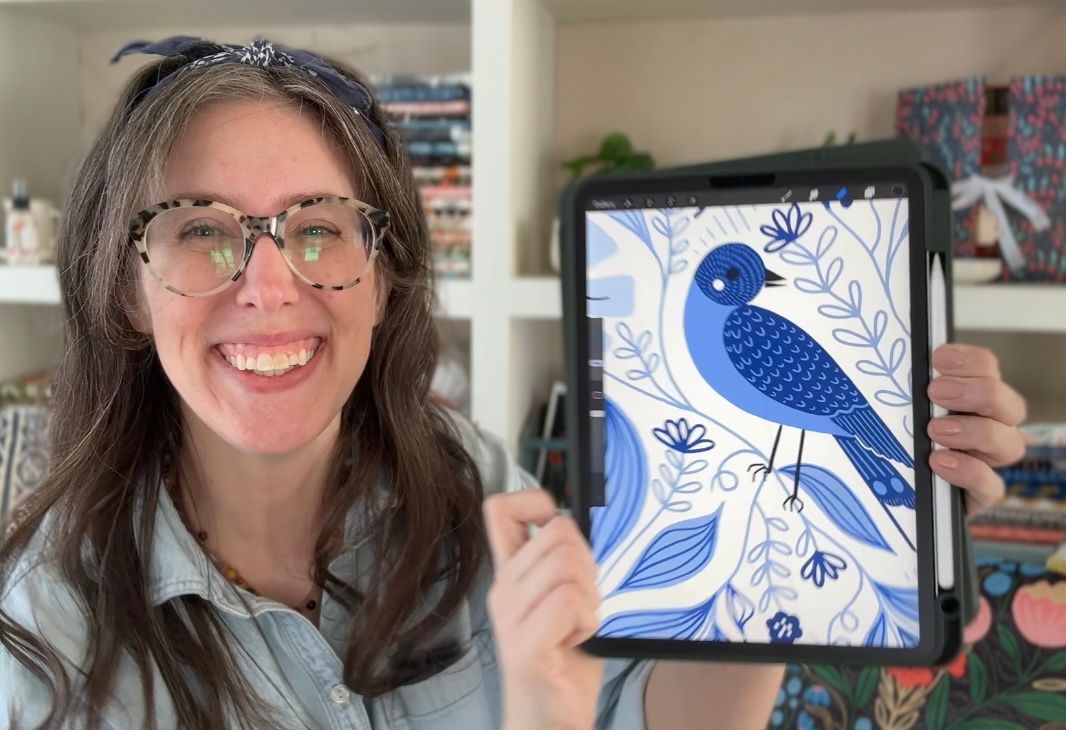
Elizabeth Berglund: How Leverage Your Art Changed Her Perspective as an Artist
Today I'm sharing a story from one of my Leverage Your Art graduates — a story that captures exactly why I built this course and why I keep teaching it.
Elizabeth Berglund is a freelance graphic designer, illustrator, and art director based in Memphis, Tennessee. She'd always dreamed of creating more for herself — surface design specifically — but felt like she was leaving that dream on the table while serving her clients' creative visions instead. Leverage Your Art helped her change that.
Who Elizabeth Is and What She Was Trying to Build
For her client work, Elizabeth focuses on branding — helping other businesses find their visual identity. She's good at it. But she wanted to do the same for herself. She'd taken a class on surface design, fallen in love with it, and wanted to make it a profitable, consistent part of her business — eventually scaling back on client work and building surface design into multiple income streams.
The dream was clear. The path wasn't. And that gap — between knowing what you want and knowing how to get there — is exactly what Leverage Your Art is designed to close.
What Was Getting in Her Way
Before Leverage, Elizabeth struggled to make time for art she was making for herself. Knee-deep in branding for clients, she'd gotten used to designing in other people's voices. She wanted to find her own — and kept watching younger artists living the creative life she wanted, building their portfolios, licensing their work, making it look possible. She knew she was behind. She also knew she had everything she needed to catch up. She just needed a system.
What finally pushed her over the edge: watching her mom start a business when she was almost 50. If her mom could bet on herself at that stage of life, Elizabeth could too.
Why Leverage Your Art Was Different from the Free Stuff
Elizabeth had done the rounds of free workshops for beginning creative entrepreneurs — the kind that exist mostly as lead generation for paid products and deliver very little real information. Leverage Your Art felt different from the first interaction she had with my content. She learned something real in the free material. That learning made her confident the paid course would deliver — and it did.
Watching me give live 1:1 portfolio reviews and talk honestly about slow growth — not pretending it happened overnight — sealed the decision. Elizabeth needed someone who told the truth about the journey, not the version of it that makes for a better highlight reel.
How the Course Changed Things
By the end of the eight weeks, Elizabeth had a real body of work she was ready to pitch to art directors. She had confidence in every step of the process. She'd learned to carve out creative time for herself — even just 30 minutes — and discovered that was enough to start figuring out her genuine artistic voice. She opened a Spoonflower shop, built a lookbook, did market research, added a surface design section to her website, and attended Surtex to observe buyer and art director conversations firsthand.
She also worked through something that used to block her: the idea of starting her own product line. She'd resisted it because she didn't know how to balance ethical production with accessible pricing. The course's lesson on ethical sourcing answered that question — and now she's excited to build that part of her business.
Why Stacie, Specifically
Elizabeth felt a personal connection to how I show up: not as a carefully curated persona, but as someone who encourages slow growth, speaks openly about challenges and mistakes, and shares a real wealth of knowledge about what success in this space actually looks like. On a deeper level, I happened to share a diagnosis that Elizabeth also lives with — and I mentioned it in the context of running a business. That detail mattered to her in a way that sealed the trust.
That's something I believe in strongly: the more authentic you are about your real experience — the whole of it — the more people can see themselves in your story.
Is Leverage Your Art Right for You?
Elizabeth recommends Leverage Your Art to any artist who wants to build a purposefully profitable business they're proud of. Whether you're a graphic designer trying to create more for yourself, a surface designer looking for a path to licensing, or someone who's been avoiding the business side because no one ever showed you how it worked — this is the course Elizabeth wishes she'd found sooner. You can also check out The Artist's Side Hustle as a first step — it's the book version of everything Elizabeth found in the course.
Frequently Asked Questions About Leverage Your Art
Who is Leverage Your Art for?
Leverage Your Art is for artists who already create and want to build a profitable business from their work. It's especially suited for illustrators, surface pattern designers, and fine artists who want to move into licensing, wholesale, or product-based income — and who want a clear, step-by-step system rather than piecing it together from free content alone. You don't need an art degree, but you do need to already be making work you believe in.
What do you actually learn in Leverage Your Art?
The course covers how to build a marketable portfolio, how to identify the right companies to pitch, how to write and send licensing pitches, how to price your work, and how to set up the business infrastructure that makes all of it sustainable. Graduates leave with a portfolio ready to pitch, clarity on their signature style, and a real understanding of how to move their art from their studio into the market.
How is Leverage Your Art different from free art business resources?
Free resources tend to be incomplete — they generate interest in the paid offer but don't deliver the full picture. Leverage Your Art is the full picture: the specific, sequenced curriculum that takes you from portfolio to pitch to deal. Elizabeth Berglund, a professional graphic designer, had taken multiple free workshops before Leverage and said it was the first place she learned something genuinely actionable rather than a lead-up to a sales pitch.
About Stacie Bloomfield
Stacie Bloomfield is the founder of Gingiber, a surface pattern design and art licensing brand she built from her dining room table into a multimillion-dollar business with products in 1,400+ brick-and-mortar stores. She has earned $500K+ through art licensing and has taught 5,000+ artists how to build real income from their work.
She is the author of The Artist's Side Hustle (Hay House), a Moda fabric designer, and the host of the Art + Audience podcast. Her programs — including Side Hustle Society, Leverage Your Art, and the Art Licensing Pitch Playbook — help artists at every stage turn their creativity into consistent income.
StacieBloomfield.com needs the contact information you provide to us to contact you about our products and services. You may unsubscribe from these communications at anytime. See our privacy policy for terms and conditions and to learn how we protect your data.