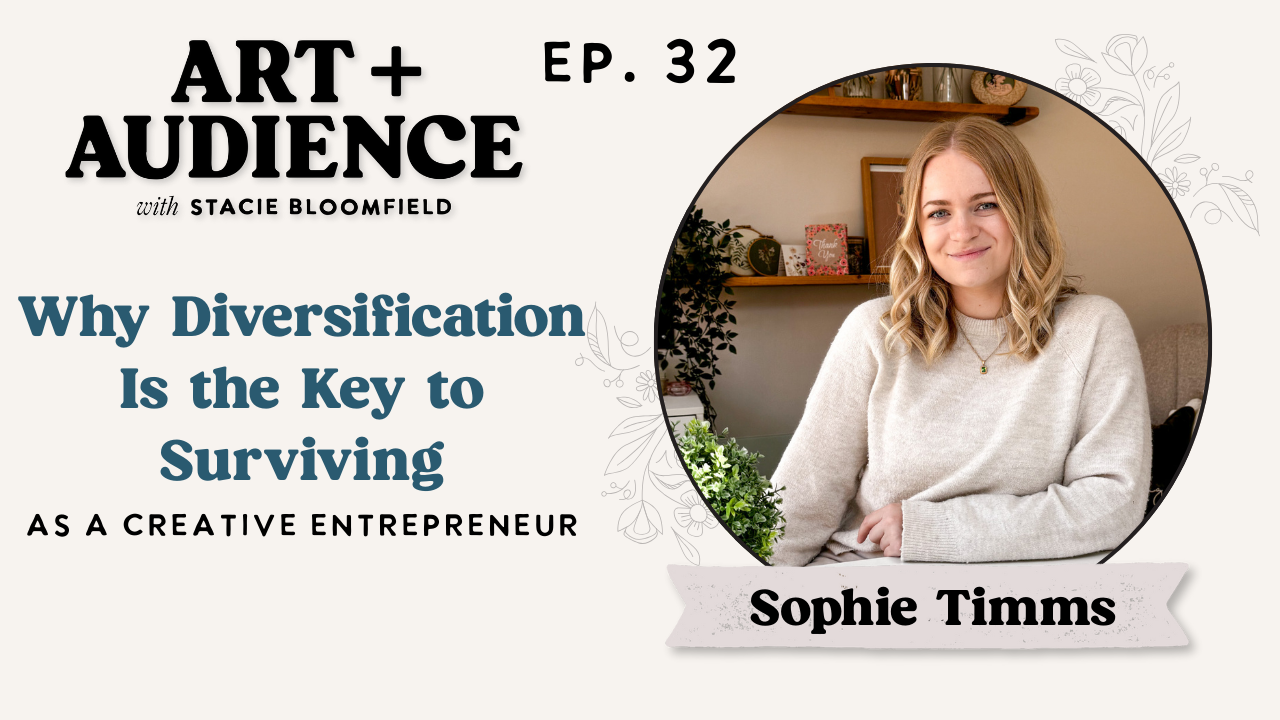
Why Diversification Is the Key to Surviving as a Creative Entrepreneur with Sophie Timms
🎧 Listen to this episode: Apple Podcasts
Sophie Timms left a law career in the UK to pick up an embroidery hoop during lockdown. What started as a creative escape became a membership community with nearly 200 members and a 93% retention rate — built almost entirely solo, with a toddler at home, through systems and heart.
In this episode of the Art + Audience podcast, Stacie Bloomfield talks with Sophie about what it actually looks like to build a diversified creative business from the ground up — one product at a time, always following the audience's lead. And then watching a 65% drop in US sales because of tariffs, and surviving it because you built more than one income stream.
Stacie has taught 5,000+ artists through programs like Leverage Your Art and knows this pattern well: the artists who build lasting businesses are the ones who diversify intentionally, not desperately. Sophie's story is a masterclass in doing it right.
RESOURCES MENTIONED IN THIS EPISODE:
- mindfulmantraembroidery.com — Sophie's shop: embroidery kits, supplies, and digital patterns. Note: US shipping is currently paused due to tariff issues — check her site for current status.
- @mindfulmantra_embroidery on Instagram — Follow Sophie for embroidery tutorials, membership updates, and the honest side of running a creative business.
- Side Hustle Society — Stacie's membership community for artists building real businesses. Sophie's Bloom Embroidery Academy model — skill roadmaps, weekly fresh content, 93% retention — is the kind of thing Stacie's community talks about and applies in their own work.
HERE ARE THE 5 KEY TAKEAWAYS FROM THIS EPISODE:
1️⃣ Follow Your Audience — They'll Tell You What to Build Next
Sophie didn't start with a membership. She started with digital embroidery patterns on Etsy. Then her audience asked for kits. Then supplies. Then a place to learn together. Each new product emerged from listening to what people were actually asking for.
"I followed my audience," Sophie says. "They told me what they needed, and I just made it happen." This is the opposite of building in isolation and hoping something lands. It's responsive entrepreneurship — watching what your customers are struggling with and solving it for them, one product at a time. Every artist already has a version of this information available to them in their DMs, comments, and email replies. Most just aren't listening systematically.
2️⃣ Membership Retention Is Built on Structure and Community, Not Content Volume
The Bloom Embroidery Academy has a 93% retention rate. That's not because Sophie posts constantly — it's because she built a membership with a clear progression system and a genuine community culture.
Members move through skill-building roadmaps. Weekly Flourish Friday content keeps things fresh without overwhelming. Monthly challenges and automated rewards keep engagement up without requiring Sophie to manually tend to every interaction. High retention comes from making members feel like they're growing — not just getting content dumped on them. That distinction is worth writing down if you're building any kind of recurring revenue model.
Stacie Bloomfield runs Side Hustle Society on similar principles: the community matters as much as the curriculum.
3️⃣ Multiple Income Streams Aren't a Backup Plan — They're the Business Model
When US tariffs caused Sophie's American orders to drop 65%, her business didn't collapse. It adjusted. Because she had digital pattern sales, physical kits (to other markets), membership revenue, workshops, and her Etsy shop all running simultaneously.
Diversification isn't what you build when one stream fails — it's what you build so that one stream failing doesn't take everything else with it. Sophie is explicit about this: "I'm just really grateful that I figured out how to put more eggs in more baskets." That decision, made before the crisis, is what kept her business stable when an external shock she had no control over hit hard.
4️⃣ Systems and Automation Let You Stay Small While Scaling Your Impact
Sophie runs her membership mostly solo, with a toddler at home. She makes this work by automating everything she can — member rewards, community workflows, email sequences — so her hands-on time goes to the things that can't be automated: creating, connecting, and serving.
"I thrive on making things simple," she says. "If I want to be successful, I can't do everything manually." This is a lesson that tends to hit artists late — often after they've burned out trying to personally respond to everything. The earlier you build the automations, the sooner you free yourself to do the work that actually requires you. Work smarter isn't a cliché. It's a survival strategy.
5️⃣ You Can Pivot from Any Career — What Matters Is That You Start
Sophie had a law degree, a master's, and a clear track toward becoming a solicitor. She gave it up for embroidery because lockdown gave her a window to discover what actually lit her up — and she took it seriously when she found it.
The career you're leaving isn't wasted. Every skill transfers. Sophie's legal training gave her attention to detail and a systematic mindset that makes her a better business builder. Her lockdown hobby became a business because she treated her curiosity as information, followed it where it led, and built something real when the signal was clear. If you're in a career that doesn't feel right, you're not starting from zero — you're starting with everything you've learned so far.
MORE FROM SOPHIE TIMMS
Find Sophie and her work here:
🌐 Website: mindfulmantraembroidery.com
📸 Instagram: @mindfulmantra_embroidery
SUBSCRIBE & REVIEW THE ART + AUDIENCE PODCAST
If this episode sparked something for you, the best way to support the show is to subscribe and leave a review on Apple Podcasts. It takes 30 seconds and helps other artists find us. New episodes drop every week — subscribe so you never miss one, and share this with a creative friend who needs to hear it.
Frequently Asked Questions About Diversifying Your Creative Business
How do you diversify your art business income without spreading yourself too thin?
Add one stream at a time, following your audience's requests rather than guessing. Sophie Timms started with digital patterns on Etsy, then added kits when customers asked for them, then supplies, then a membership. Each stream was validated before the next was added. Diversification that follows audience demand is sustainable — diversification from anxiety is what leads to overwhelm.
How do you build a membership community with high retention?
Build a progression system, not just a content library. Sophie's Bloom Embroidery Academy achieves 93% retention because members move through a skill roadmap, not just receive weekly drops. Pair that with community rituals (like Flourish Fridays and monthly challenges) and automated engagement touchpoints, and members feel like they're growing — which is why they stay.
How do you protect your creative business from things you can't control — like tariffs or platform changes?
Multiple income streams are the best protection. When Sophie's US orders dropped 65% due to tariffs, her business remained stable because she had digital sales, an international physical customer base, membership revenue, and workshops running simultaneously. No single external event could take down all of her streams at once. Build across channels and geographies before you need the protection, not after.
About Stacie Bloomfield
Stacie Bloomfield is the founder of Gingiber, a surface pattern design and art licensing brand she built from her dining room table into a multimillion-dollar business with products in 1,400+ brick-and-mortar stores. She has earned $500K+ through art licensing and has taught 5,000+ artists how to build real income from their work.
She is the author of The Artist's Side Hustle (Hay House), a Moda fabric designer, and the host of the Art + Audience podcast. Her programs — including Side Hustle Society, Leverage Your Art, and the Art Licensing Pitch Playbook — help artists at every stage turn their creativity into consistent income.
StacieBloomfield.com needs the contact information you provide to us to contact you about our products and services. You may unsubscribe from these communications at anytime. See our privacy policy for terms and conditions and to learn how we protect your data.